

Metro Line 15
Saint-Denis Pleyel
Pont de Sèvres
A major project, Line 15 is scheduled to be operational from spring 2027. This new automatic metro line, 75 km long, is one of the flagship elements of the Grand Paris Express, led by the Société des grands projets (formerly Société du Grand Paris). It will form a loop encircling Paris, passing through Pont de Sèvres, Saint Denis Pleyel, and Noisy – Champs, the terminus of the small branch that will connect with the future Metro Line 16. Metro Line 15 will cross 45 cities across four departments and serve no fewer than 36 stations along its route. It will offer a very convenient connection between major transfer points for the residents of Île-de-France and visitors to the region. The new Metro Line 15 indeed provides connections with 12 metro lines, 5 Transilien lines, 8 tramway lines, and all RER lines. The frequency of the trains and the speed of the line are designed to offer a more comfortable quality of life to daily users of the public transport network, who will save precious hours each week. Each train is equipped with high-speed WiFi and 5G, as well as USB ports available to travelers.
Metro line 15 map
Click on the map to enlarge.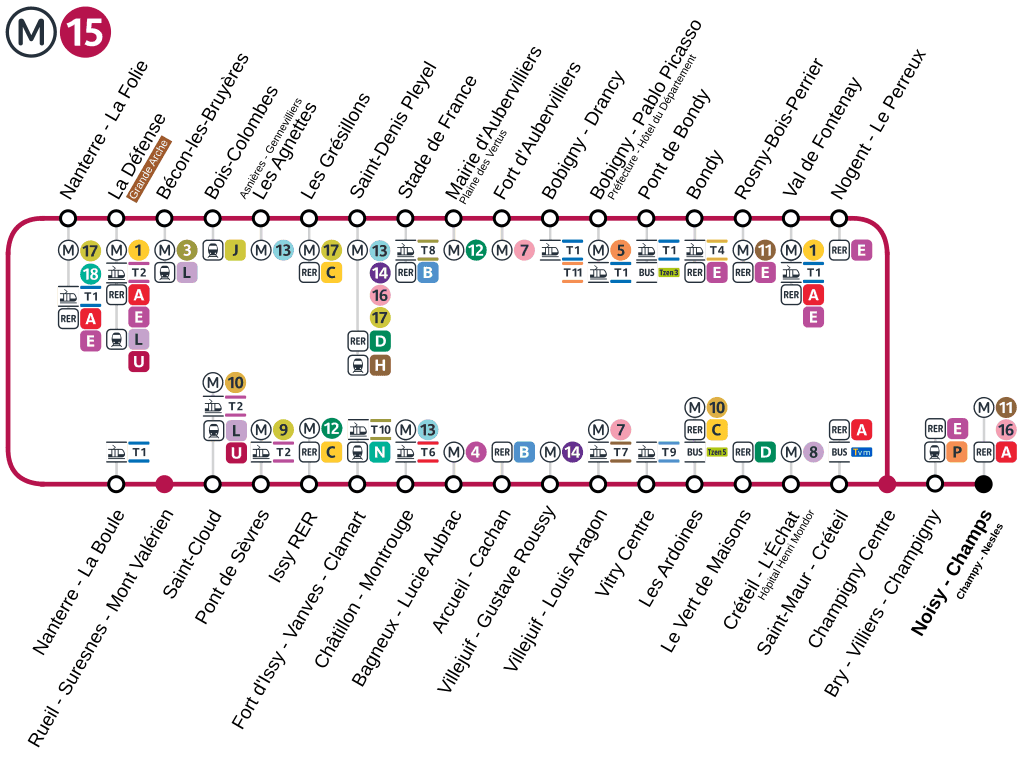
What is the planned opening date for Line 15?
The opening of Metro Line 15 is scheduled for spring 2027 on an initial section between Pont de Sèvres and Noisy-Champs. The rest of the line is expected to be operational by 2031 for the sections between Champigny Centre and Saint-Denis – Pleyel, and between Pont de Sèvres and Saint-Denis – Pleyel.
What is the route of Line 15?
With 45 cities involved over 75 km, this new line will be particularly extensive. It will form a large loop similar to a ring road around Paris and will cross the departments of Seine-Saint-Denis, Val-de-Marne, Hauts-de-Seine, and Seine-et-Marne. It will pass through stations such as Aubervilliers, Bobigny, Bondy, Rosny, Noisy-Champs, Créteil, Villejuif, Montrouge, Issy, Saint-Cloud, Nanterre, and Bois-Colombes, among others. Also note that the Metro Line 16 project will offer a connection extending Line 15, further enlarging the loop in the northeast of Paris.
What are the possible connections on Line 15?
This line encircling Paris offers a particularly practical complement to the current star-shaped network. There are numerous connection points, as 95% of the stations on Line 15 provide connections with Île-de-France public transport. During your journeys, you will find connections with:
- Parisian and suburban metro lines 1, 4, 5, 7, 8, 9, 11, 12, 13, 14, 16, and 17
- RER lines A, B, C, D, and E
- Transilien lines J, L, N, P, and U
- Tram lines T1, T2, T4, T6, T7, T8, T9, T11
Additionally, Line 15 will also offer connections with the Altival bus network and the Tvm line in Val-de-Marne, as well as Tzen lines 3 and 5. The main connection points of this metro project are the stations La Défense, Saint-Denis – Pleyel, and Val de Fontenay.
What places are served by Metro Line 15?
Several cultural and leisure venues will be accessible:
- The La Défense district, its concert hall, and shopping center,
- The Stade de France,
- La Seine Musicale (Pont de Sèvres station),
- The Val-de-Marne Contemporary Art Museum MAC/VAL (Mairie de Vitry-sur-Seine station),
- The Domaine National de Saint-Cloud.
Line 15 will facilitate access to numerous economic hubs and thousands of jobs, particularly in the La Défense district and the Plaine Saint-Denis area. Students will also benefit, as many institutions like Paris-Est Créteil or the Cité Descartes are just minutes away from Metro Line 15 stations.
Its route will also provide access to many healthcare centers, such as Avicenne Hospital (Drancy – Bobigny station) or the Gustave Roussy Institute (Villejuif – Gustave Roussy station). With its new stations and an extensive metro network in the suburbs, the Grand Paris Express will enhance the attractiveness of the served cities and improve the daily lives of the residents of Île-de-France.
Frequently Asked Questions
There will be 36 stations on Metro Line 15, all located in the suburbs
Yes, Line 15 will save time on suburban travel. Its fully automatic trains will travel at an average speed of 55 to 65 km/h, and the line will operate with a frequency of 2 to 3 minutes during peak hours. To accommodate the expected high ridership, each train can carry up to 1,000 passengers. Travelers will be able to reach several points of interest in the suburbs without having to go through Paris. For example, you can travel from Champigny-sur-Marne to the Stade de France in about 23 minutes. Currently, this journey takes twice as long. This is a valuable time saving for daily commutes on the Île-de-France public transport network.