Transport accessibility in Paris and Île-de-France: useful information and maps Better prepare your journey with reduced mobility
On public transport, these situations will sound familiar to many travelers: a stroller to carry up a staircase, a wheelchair facing a station without an elevator, or luggage that is difficult to carry during long transfers.
These situations are a reminder that getting around on public transport requires planning ahead when mobility is reduced, whether permanently or temporarily. To support the travelers concerned, several tools and resources help identify the most accessible stations and prepare your journey with greater peace of mind on public transport in Île-de-France.
Who is affected by reduced mobility?
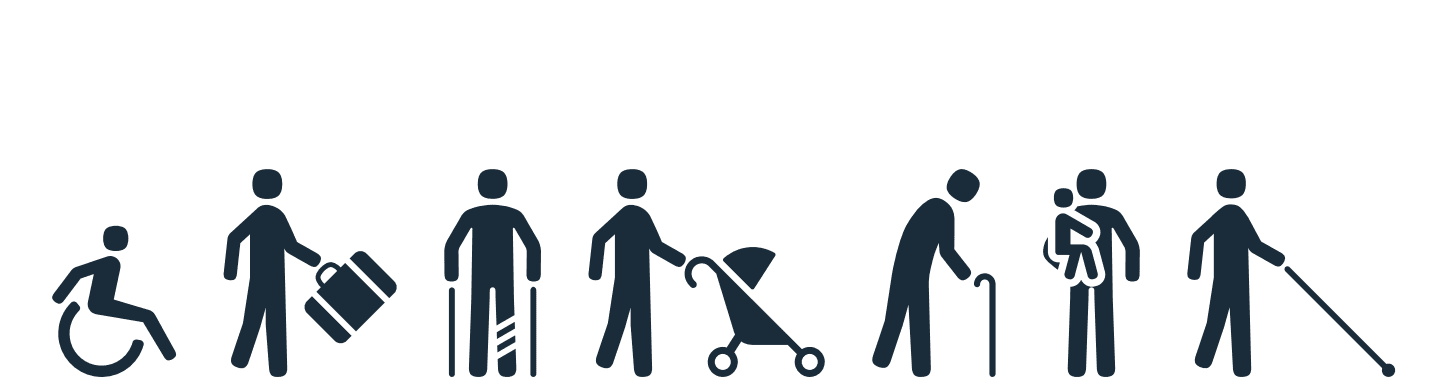
The concept of a person with reduced mobility (PRM) concerns many travelers and everyday situations. It includes in particular:
- people in wheelchairs
- people who are visually impaired or blind
- elderly people
- parents with strollers
- travelers with bulky luggage
- people experiencing a temporary difficulty in getting around
In these situations, certain facilities can make access to transport easier and make the journey more comfortable.
Stations that are more or less accessible depending on the network
The Paris network is one of the oldest in the world. Because of its history and architecture, not all stations offer the same level of accessibility.
Some stations are easy to access with elevators or step-free access, equipped with escalators and not very deep. Others, on the contrary, are deeper and can only be reached by stairs. Knowing these differences can help you choose the most suitable stations and anticipate certain connections.
Please note:
-
 All bus lines in Paris are declared accessible to wheelchair users. In the suburbs, 86% of lines are declared accessible as of 2025. The remaining lines are currently being adapted. Please note: some stops may not be accessible; they are indicated by the corresponding pictogram on line maps, which can be viewed in the Bonjour RATP app.
 -
 All tram lines are accessible to wheelchair users independently.
Dedicated maps and guides to identify accessible stations
To help you prepare your journey, several accessibility maps of the network are available. They make it easy to quickly identify the stations best suited to your needs.
These maps indicate in particular:
- the presence of elevators or escalators
- easy-access stations
- stations equipped only with stairs
- the layout of stations within the network
📥 You can view or download these documents:
Transport map for people with reduced mobility (PRM)
Easy-to-read map for visually impaired travelers
Accessibility map for wheelchair users (WCU)
Guide for a journey by wheelchair

Prepare your journey to travel with greater peace of mind
Here are some practical tips to plan ahead for your trip using the Bonjour RATP app:
- Check accessibility for lines, stations, and stops using the pictograms in the Maps tab
- Check traffic status on your favorite lines via the Traffic tab
- Plan a route using the Mode > Reduced Mobility filter from the Home screen
Need help at a station? Intercoms are available to contact a staff member if needed. They are located near ticket machines, validators, escalators and elevators, on platforms, and in some long corridors.